
Contents
Overview
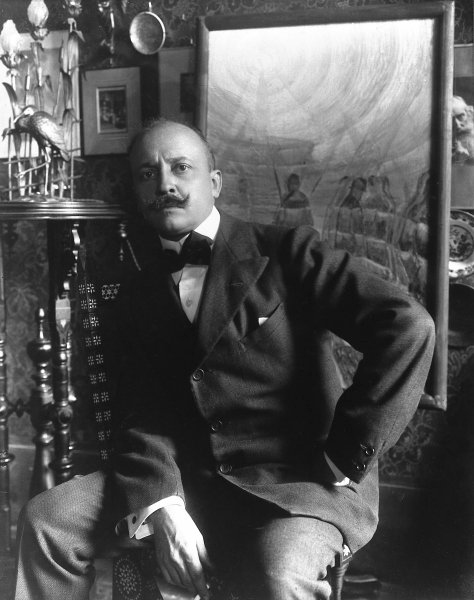
Filippo Tommaso Marinetti (1876-1944) was an Italian poet, editor, and the incendiary founder of the Futurist movement. He burst onto the scene in 1909 with the publication of the 'Manifesto of Futurism,' a radical declaration that championed speed, technology, violence, and the destruction of the past. Marinetti's work and ideology profoundly influenced 20th-century art, literature, and design, advocating for a complete break from tradition and embracing the dynamism of the modern world. His embrace of aggressive nationalism and later his association with Benito Mussolini's Fascist regime remain deeply controversial aspects of his legacy, illustrating the complex and often troubling intersections between avant-garde art and political extremism. Marinetti's relentless pursuit of novelty and his provocative style left an indelible, albeit contested, mark on cultural history.
🎵 Origins & History
Filippo Tommaso Marinetti's early education spanned schools in Egypt and Italy. He began publishing poetry and essays in various journals, but it was his audacious 'Manifesto of Futurism,' published in Le Figaro on February 20, 1909, that truly ignited his career and launched a global artistic movement. This manifesto, a fiery rejection of museums, libraries, and all forms of traditionalism, called for a new aesthetic celebrating the machine age, war, and dynamic energy. Marinetti's early association with the Abbaye de Créteil artistic community in France between 1907 and 1908 provided a brief, albeit contrasting, period of Symbolist influence before he fully committed to his revolutionary Futurist vision. His prolific output and tireless promotion established Futurism as a major force in early 20th-century art.
⚙️ How It Works
Futurism, as conceptualized and propagated by Marinetti, was less a rigid artistic style and more a radical ideology aimed at shattering existing cultural norms. Its core mechanics involved a deliberate assault on syntax and traditional literary forms, famously articulated in Marinetti's 'Technical Manifesto of Futurist Literature' (1912). He advocated for 'words-in-freedom' (parole in libertà), abolishing punctuation, adjectives, and adverbs to create a more direct, onomatopoeic, and visually dynamic expression. This extended to other art forms: Futurist painters depicted motion and the machine, while composers like Luigi Russolo explored noise music with his Intonarumori instruments. Futurist evenings ('serate futuriste') were designed to incite audience reaction, mirroring the chaos and dynamism of modern urban life and warfare.
📊 Key Facts & Numbers
Futurism's influence reached across Europe and even to Russia, where it interacted with Suprematism and Constructivism. Marinetti himself was a prolific writer, publishing over 30 books. His 'Manifesto of Futurism' alone has been translated into dozens of languages, demonstrating its global reach. The movement’s core tenets, particularly its embrace of speed and technology, were adopted by various design fields, influencing everything from typography to automotive design. Despite its peak influence in the 1910s and 1920s, Futurist ideas continued to resonate, with estimates suggesting over 1,000 Futurist exhibitions and events held worldwide in the century following its inception.
👥 Key People & Organizations
Filippo Tommaso Marinetti was the undisputed architect and driving force behind Futurism, but he collaborated with and inspired a constellation of influential figures. Key among these were painters like Umberto Boccioni, Carlo Carrà, Luigi Russolo, Gino Severini, and Giacomo Balla, whose artistic innovations brought Futurist theories to life visually. His wife, Benedetta Cappa Marinetti, was also a significant Futurist artist in her own right, contributing to painting, writing, and performance. Politically, Marinetti co-authored the Fascist Manifesto in 1919, aligning himself with Benito Mussolini and the nascent Fascist Party, a move that would later complicate his legacy. Organizations like the Futurist Party (founded 1918) and later the Italian National Fascist Party became platforms for his political ambitions, though his relationship with the regime evolved over time.
🌍 Cultural Impact & Influence
The cultural impact of Futurism, largely driven by Marinetti's relentless promotion, was immense and far-reaching. It fundamentally challenged the established artistic and literary canons of the early 20th century, paving the way for subsequent avant-garde movements like Dadaism and Surrealism. Marinetti's 'words-in-freedom' concept directly influenced graphic design and typography, with artists like El Lissitzky and Jan Tschichold exploring similar typographic innovations. The movement's glorification of the machine and speed resonated deeply with industrial design, advertising, and even architectural concepts, as seen in the work of architects like Antonio Sant'Elia, who envisioned a dynamic, mechanized urban future. Beyond the visual arts, Futurist ideas permeated literature, theater, and music, encouraging experimentation and a rejection of bourgeois sensibilities. Even the concept of performance art owes a debt to the provocative Futurist 'serate.'
⚡ Current State & Latest Developments
While Futurism as a cohesive movement largely waned after World War II, its echoes persist. Marinetti's own engagement with the Fascist regime meant that his legacy became inextricably linked with political ideology, leading to a complex re-evaluation of his work in the post-war era. However, the core Futurist aesthetic—its dynamism, embrace of technology, and experimental spirit—continues to inspire contemporary artists and designers. Modern explorations of digital art, kinetic sculpture, and experimental literature often draw upon Futurist principles of breaking boundaries and embracing new media. The ongoing debate surrounding the relationship between avant-garde art and political power, exemplified by Marinetti's trajectory, remains a live issue in cultural discourse, particularly as new technologies and political movements emerge.
🤔 Controversies & Debates
Marinetti's legacy is fraught with controversy, primarily stemming from his political affiliations and the aggressive, often violent, rhetoric of his manifestos. His enthusiastic embrace of Italian Fascism and his role in co-authoring the Fascist Manifesto in 1919 placed him squarely in support of a regime responsible for immense suffering and oppression. While he later expressed some disillusionment with certain aspects of Mussolini's rule, he remained a prominent figure within the Fascist cultural apparatus for much of his life. Furthermore, the Futurist movement's glorification of war, violence, and destruction, as detailed in manifestos like 'The Founding and Manifesto of Futurism,' has been widely criticized as morally reprehensible and ideologically dangerous. Critics argue that this aestheticization of violence directly contributed to a cultural climate that normalized aggression and conflict, making it difficult to separate the art from its problematic political implications.
🔮 Future Outlook & Predictions
The future of Marinetti's influence likely lies in a continued critical engagement with his complex legacy. While the overt glorification of war and nationalism espoused by early Futurism is largely rejected in contemporary art, the movement's spirit of radical experimentation and its fascination with technology and speed remain potent. Future artistic and literary endeavors might explore the mechanics of Futurist innovation—its typographic experiments, its sonic explorations, its performance strategies—without necessarily endorsing its political or social agenda. There's potential for new movements to re-examine the Futurist relationship with technology, perhaps focusing on digital frontiers, artificial intelligence, or virtual realities, echoing Marinetti's original impulse to capture the dynamism of the modern age. The challenge will be to harness Futurist energy for progressive ends, rather than repeating its historical missteps.
💡 Practical Applications
While Futurism itself is not a direct 'application' in the way a software program is, its principles have profoundly shaped numerous practical fields. In graphic design and typography, Marinetti's 'words-in-freedom' directly influenced the development of modern layouts, experimental fonts, and visual communication, impacting everything from book covers to advertising campa
Key Facts
- Category
- movements
- Type
- topic