
Contents
Overview
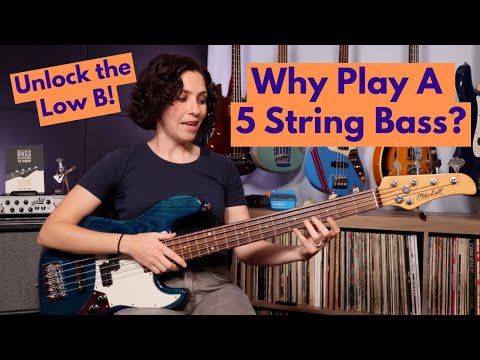
The five-string bass guitar adds a lower B or higher C string to the standard four-string instrument, significantly extending its tonal range. This allows players to access deeper lows for funk, metal, and jazz, or higher registers for melodic lines and solos. Popularized by artists like Victor Wooten and John Patitucci, the five-string has become a staple for bassists seeking greater versatility and expressive capability. While requiring some adjustment in technique, particularly for muting and finger placement, its benefits in expanding harmonic and melodic possibilities are undeniable for contemporary musicians.
🎸 What is a Five-String Bass?
The five-string bass is an electric or acoustic bass guitar that, as the name suggests, features five strings instead of the standard four. Typically, the extra string is a lower B (B-E-A-D-G tuning), though some players opt for a higher C string or alternate tunings. This added range opens up a vast sonic palette, allowing for deeper lows and more melodic possibilities. It's a significant evolution from the foundational four-string bass, offering expanded creative territory for bassists across genres.
🌟 Who Needs an Extra String?
A five-string bass is ideal for musicians who need to access notes below the standard E on a four-string, particularly those playing progressive rock, jazz fusion, metal, gospel, or contemporary R&B. If your repertoire frequently calls for those sub-E notes, or if you find yourself constantly wishing for a wider melodic range without shifting positions, the five-string becomes an indispensable tool. It's also a great choice for studio musicians who need maximum versatility in a single instrument.
🛠️ Key Features & Variations
Five-string basses come in various configurations. The most common neck profile is slightly wider than a four-string to accommodate the extra string, though many modern designs achieve this without a drastically thicker neck. Pickup configurations vary widely, from classic jazz bass pickups to powerful humbuckers, each influencing the instrument's tone. Scale length also plays a role; longer scales (35 inches or more) are often preferred for better tension and clarity on the low B string, though shorter scales are available.
⚖️ Five-String vs. Four-String Bass
The primary difference is the extended low range provided by the fifth string. While a four-string bass is perfectly capable for many styles, the five-string offers immediate access to notes like B, A#, and A below the standard E. This can simplify playing complex passages, allow for more powerful root notes in lower registers, and facilitate easier chordal voicings. However, the wider neck can present a learning curve for players accustomed to four strings, and the lower B string requires careful attention to intonation and amplification.
💰 Finding Your Five-String Bass
When shopping for a five-string bass, consider your budget and musical needs. Entry-level models from brands like Ibanez and Yamaha offer great value, while professional-grade instruments from Fender, Music Man, and Sadowsky provide superior craftsmanship and tone. Visit local music stores to try different neck profiles and pickup configurations. Don't overlook the importance of a solid amplifier and bass cabinet capable of handling the extended low frequencies.
🔧 Maintenance & Care Tips
Maintaining your five-string bass is crucial for optimal performance. Regularly check the intonation on all five strings, especially the low B, as it can be sensitive to temperature and humidity changes. Ensure your truss rod is properly adjusted to handle the increased string tension. Cleaning the fretboard and polishing the body will keep your instrument looking and playing its best. Investing in quality bass strings designed for five-string instruments is also recommended for tone and durability.
🎶 Famous Five-String Bassists
Many legendary bassists have embraced the five-string bass, expanding its sonic possibilities. John Patitucci is a pioneer, known for his virtuosic use of the instrument in jazz and fusion contexts. Victor Wooten is another master, renowned for his innovative techniques and melodic approach. Geddy Lee of Rush incorporated it into his playing, adding depth to the band's complex arrangements. Their influence has inspired countless others to explore the extended range.
🚀 The Future of the Five-String
The five-string bass continues to evolve, with manufacturers constantly innovating in neck design, electronics, and materials to improve playability and tone. We're seeing more ergonomic designs, extended-range basses with even more strings (six, seven, or even eight), and advancements in active electronics that offer greater tonal shaping. The instrument's versatility ensures its continued relevance in an ever-expanding musical landscape, pushing the boundaries of what the bass guitar can achieve.
Key Facts
- Year
- 1980
- Origin
- USA
- Category
- Musical Instruments
- Type
- Musical Instrument
Frequently Asked Questions
Is a five-string bass harder to play than a four-string?
For most players, the primary adjustment is the slightly wider neck, which can feel different under the fretting hand. The extra string also requires learning new fingerings for certain notes and chords. However, many find the added range and melodic possibilities make the learning curve worthwhile. It's less about being 'harder' and more about adapting to a different instrument.
What kind of strings should I use for a five-string bass?
You'll need a dedicated set of five-string bass strings. These sets typically include a low B string. String gauge is a matter of personal preference and depends on your playing style and desired tone. Lighter gauges can be easier to play, while heavier gauges often provide more low-end power and sustain. Brands like D'Addario, Ernie Ball, and La Bella offer excellent five-string sets.
Do I need a special amplifier for a five-string bass?
While not strictly 'special,' you do need an amplifier and cabinet that can accurately reproduce the extended low frequencies of the fifth string without distortion or 'flub.' A good quality bass amplifier with sufficient wattage and a well-designed bass cabinet is essential. Look for systems known for their clean low-end response. Some players also utilize bass effects pedals like octave pedals to further enhance their low-end sound.
Can I tune a five-string bass differently?
Absolutely. While B-E-A-D-G is the most common tuning, many players experiment with alternate tunings. Some popular options include dropping the low B to A (A-E-A-D-G), or tuning the top string to C (B-E-A-D-C). Extended range bassists often develop unique tunings to suit their specific musical needs and playing styles.
What are the advantages of a longer scale length on a five-string bass?
Longer scale lengths, typically 35 inches or more, provide increased string tension. This is particularly beneficial for the low B string, helping it maintain clarity, definition, and sustain without sounding muddy or 'floppy.' Longer scales can also contribute to a brighter overall tone and better intonation across the fretboard.
Are five-string basses more expensive than four-string basses?
Generally, yes, five-string basses tend to be slightly more expensive than their four-string counterparts due to the added complexity in manufacturing and the inclusion of an extra tuning machine, pickup, and string. However, the price difference isn't always drastic, and there are many affordable five-string options available from reputable brands.